Official Grading Guide

The PGS Grade Scale – from 1 to 10.

Every grade is based on a defined analysis of the physical characteristics – objective, traceable and based on clearly defined criteria.

Every grade clearly defined.

All grades with meaning and average. Open a grade to see centering, corners, edges and surface in detail.

With subgrades on the label · from 7.0

10Gold · PerfectAbsolute perfection. 50/50 centering. Gold Label with 4× grade 10.4 × 10

Absolute perfection. The card passes every inspection under controlled light and magnification without a single finding.

Centering
Subgrade 10: the image sits practically exactly in the middle (50 / 50).
Corners
All four tips sharp and untouched – no whitening, even under magnification.
Edges
A clean cut all the way round: no abrasion, no chipping, no nicks.
Surface
Flawless: no scratches, print lines, dents or prints, full gloss.
Calculationall four subgrades 10On the label: PERFECT · Gold LabelGold Label
10Gem MintNear perfect. Highest eye appeal.from 9.80

Near perfect, highest eye appeal. The card looks factory-fresh; deviations show up – if at all – only under magnification.

Centering
Counts 20 %. If all other values are 10, a 9 is enough (up to 57.5 / 42.5).
Corners
Sharp; at most one tiny irregularity at a single tip, visible only under magnification.
Edges
Cleanly cut; at most a microscopic light spot.
Surface
Full gloss; at most a tiny mark that only shows in raking light.
Calculationaverage from 9.80 with centering – in total at most 1 point is missing, surface counts doubleOn the label: GEM MTStandard with Subgrades
9.5Mint PlusPremium. Only minimal deviation.9.40 – 9.80

Premium. Only minimal deviation – in total, more than one and at most three points are missing to the 10.

Centering
Counts 20 % towards the final grade.
Corners
Sharp; one corner may show a minimal light spot, barely visible to the naked eye.
Edges
Clean; at most a tiny light spot on one edge.
Surface
Full gloss; at most a fine print dot or a hairline that only shows in raking light.
Calculationaverage 9.40 to below 9.80 with centeringOn the label: MINT +Standard with Subgrades
9MintFirst-class. Minimal print lines / whitening.8.80 – 9.40

First-class. Small traces from production or handling – such as minimal print lines or a touch of whitening – are possible.

Centering
Counts 20 % from here on – provided the average already reaches 8.80 without centering.
Corners
Minimal whitening on one or two corners possible; the tips stay sharp.
Edges
Light, isolated abrasion possible – no tears, no nicks.
Surface
Isolated minimal print lines or a fine scratch in raking light; the gloss is intact.
Calculationaverage 8.80 to below 9.40 with centeringOn the label: MINTStandard with Subgrades
8.5NM-MintVery good. Light traces on close inspection.8.30 – 8.80

Very good condition. Light traces are visible on close inspection, the overall impression stays high-quality.

Centering
Does not count for this grade – but appears as a subgrade on the label.
Corners
Light whitening on several corners; the tips are still largely sharp.
Edges
Light abrasion in a few places, small light spots.
Surface
Light print lines or fine scratches in raking light; no crease, no dent.
Calculationaverage 8.30 to below 8.80 without centeringOn the label: NM-MINTStandard with Subgrades
8NM-MintVery good. Light signs of wear.7.75 – 8.30

Very good, with light signs of wear. This is also where the common case 8 / 8 / 8 / 8.5 with an average of 8.25 lands.

Centering
Does not count, appears as a subgrade on the label.
Corners
Light whitening on several corners; one tip may be minimally blunted.
Edges
Light abrasion along one or more sides, occasional small chips.
Surface
Some fine scratches or light print lines; gloss slightly reduced, no creases.
Calculationaverage 7.75 to below 8.30 without centeringOn the label: NM-MINTStandard with Subgrades
7.5Near MintWell preserved. Wear visible, not dominant.7.25 – 7.75

Well preserved. Signs of wear are visible but not dominant.

Centering
Does not count, appears as a subgrade on the label.
Corners
Visible whitening on several corners.
Edges
Visible abrasion in several places, small chips.
Surface
Several fine scratches or clear print lines, reduced gloss.
Calculationaverage 7.25 to below 7.75 without centeringOn the label: NEAR MINTStandard with Subgrades
7Near MintVisible whitening or scratches.6.50 – 7.25

Visible whitening or scratches. The lowest grade that still appears with subgrades on the label. An average of exactly 6.50 already counts as a 7.

Centering
Does not count, appears as a subgrade on the label.
Corners
Clear whitening, individual corners slightly blunted.
Edges
Clear abrasion, several small chips.
Surface
Visible scratches or a light dent; no creases yet.
Calculationaverage 6.50 to below 7.25 without centeringOn the label: NEAR MINTStandard with Subgrades

Standard Label · below 7.0

6EX-MintNoticeable wear or dirt.5.50 – 6.50
Corners & edges
Rounded or blunted corners, clear abrasion and loss of color on the edges.
Surface
Several visible scratches, loss of gloss, light soiling; no creases yet.
Calculationaverage 5.50 to below 6.50On the label: EX-MINTStandard Label
5ExcellentHeavy scratches or clear abrasion.4.50 – 5.50
Corners & edges
Clearly rounded corners, heavy abrasion all round, small nicks.
Surface
Heavy scratches and dull spots, but no crease.
Calculationaverage 4.50 to below 5.50On the label: EXCELLENTStandard Label
4VG-ExcellentVisible defects or discoloration.3.50 – 4.50
Corners & edges
Heavily worn corners, frayed edges.
Surface
Discoloration, stains or dents, clear loss of gloss.
Calculationaverage 3.50 to below 4.50On the label: VG - EXStandard Label
3Very GoodLight creases. Clear scratches.2.50 – 3.50
Corners & edges
Round, heavily blunted corners, clearly damaged edges.
Surface
Light creases, clear scratches, visible soiling.
Calculationaverage 2.50 to below 3.50On the label: VERY GOODStandard Label
2GoodHeavy creases and soiling.1.50 – 2.50
Corners & edges
Severely damaged, small tears possible.
Surface
Heavy creases, stains and soiling.
Calculationaverage 1.50 to below 2.50On the label: GOODStandard Label
1PoorMassive damage. Deep creases.0.75 – 1.50
Corners & edges
Most severe damage, tears possible.
Surface
Deep creases, heavy soiling, water or pressure damage.
Calculationaverage 0.75 to below 1.50On the label: POORStandard Label

Special case

AAuthenticGenuine, but condition cannot be assessed objectively.below 0.74

The card is genuine, but its condition cannot be assessed objectively.

Typical reasons
Too heavily damaged, overpainted, concealed flaws or other subsequent modifications.
Autographs
Subsequent signatures count as well – unless you include proof of authenticity or it is an official autograph card.
Calculationaverage below 0.74On the label: AUTHENTIC

How to read the average: The lower boundary belongs to the band, the upper one does not – an average of exactly 8.30 is already an 8.5, while 8.25 is still an 8.0. Up to 8.5 we calculate without centering, from 9.0 with it.

Half grades possible: In the upper range we also award half grades – 9.5, 8.5, 7.5 and 6.5. That is where small details decide the value, so we measure more finely. From 6.0 downwards we award whole grades.

Autographs & signatures: We can grade signed cards if you include proof of authenticity – e.g. photo or video evidence of the signing or other authentication. Official autograph cards (certified autos) are of course also possible.

Typical picture, fixed calculation: the descriptions show what a card with this grade usually looks like. What counts in the end are the four subgrades and the formula – a card with a single weakness can therefore land higher than the description of that one criterion suggests.

How the grade is calculated.

Four criteria with fixed weights, one fixed formula, fixed grade bands.

40%

Surface

Surface, scratches and gloss. Under special lighting we inspect every card for the finest marks and loss of shine.

20%

Corners

Shape and integrity of the corners. Even the finest corner wear influences the assessment.

20%

Edges

Cut quality and color abrasion of the edges. We check for nicks, abrasion and discoloration.

20%

Centering

Image alignment and symmetry. Centering enters the final grade from a potential 9.0 upwards.

01 · Standard calculation · Grade < 9.0

Without centering

G = (2S + C + E) ÷ 4

For grades below 9.0, surface, corners and edges count – with surface weighted twice.

02 · Premium calculation · Grade ≥ 9.0

Including centering

G = 0.4·S + 0.2·C + 0.2·E + 0.2·Z

From 9.0 upwards, centering (Z) enters the final grade with 20 %.

03 · Final result

Fixed grade bands

8.25 → 8.0

The result falls into a fixed grade band. The lower boundary belongs to the band, the upper one does not – 8.25 is still inside the 8.0 band (up to below 8.30) and therefore yields an 8.0, not an 8.5. All boundaries are in the grade list.

S = Surface C = Corners E = Edges Z = Centering G = overall grade · Gf = final grade

Info on centering: Centering only enters the final grade from a potential 9.0 upwards – specifically, as soon as the average without centering reaches 8.80. If a result sits exactly on a boundary, the higher grade applies: the lower boundary belongs to the band, the upper one does not.

Centering in numbers

Border ratio and centering subgrade, from 50 / 50 to 70 / 30

These guide values are stored in our grading system for the centering subgrade. We measure left to right and top to bottom – the weaker of the two axes always counts. The bar shows how far the image is off the exact center: far left would be 50 / 50, far right 75 / 25.

10practically 50 / 50No visible difference between opposite borders to the naked eye.
9.5up to 55 / 45Minimally off-center: the wider border is at most about 1.2 times the narrower one.
9up to 57.5 / 42.5Slightly off-center: at most about 1.35 times as wide.
8.5up to 60 / 40Noticeably off-center: at most 1.5 times as wide.
8up to 62.5 / 37.5Visible at first glance: at most about 1.7 times as wide.
7.5up to 65 / 35Clearly off-center: at most about 1.9 times as wide.
7up to 70 / 30Strongly off-center: at most about 2.3 times as wide.
< 7worse than 70 / 30Off-center – the grader then assesses centering individually.

Example: left/right 54 / 46, top/bottom 58 / 42 → the 58 / 42 counts → centering 8.5. We look at the front and the back separately – everything that matters is explained under Subgrades. For the final grade: centering only counts from a potential 9.0 upwards.

Worked examples

Six cards, calculated. Z stands for centering, C for corners, E for edges, S for surface.
Z10C10E10S10
without Z: (2·10 + 10 + 10) ÷ 4 = 10.00with Z: (2·10 + 10 + 10 + 10) ÷ 5 = 10.00
10Perfect · Gold Label

Four times a 10 – only then do you get the Gold Label.

Z9C10E10S10
without Z: (2·10 + 10 + 10) ÷ 4 = 10.00with Z: (2·10 + 10 + 10 + 9) ÷ 5 = 9.80
10Gem Mint

Exactly one point is missing. That is still enough for the 10 – for the Gold Label all four values would have to be 10.

Z8C9.5E9.5S9
without Z: (2·9 + 9.5 + 9.5) ÷ 4 = 9.25with Z: (2·9 + 9.5 + 9.5 + 8) ÷ 5 = 9.00
9Mint

From 8.80 upwards centering is included – and the 8 pulls the average down to 9.00. The 9.5 is still 0.40 away.

Z10C9.5E9.5S8
without Z: (2·8 + 9.5 + 9.5) ÷ 4 = 8.75below 8.80 – centering does not count
8.5NM-Mint

Perfect centering does not help here: without it, the average stays just below 8.80 – so the grade stays at 8.5.

Z8C8E8S8.5
without Z: (2·8.5 + 8 + 8) ÷ 4 = 8.25below 8.30 – not yet an 8.5
8NM-Mint

The common case: the 8.5 in surface counts double – yet the 8.5 is still 0.05 away.

Z6C7.5E7.5S7.5
without Z: (2·7.5 + 7.5 + 7.5) ÷ 4 = 7.50below 8.80 – centering does not count
7.5Near Mint

If centering counted, the average would be 7.20 – a 7. Below 9.0 it stays out; it still appears on the label.

Transparency meets design.

Every label shows year, TCG, language, set, card name, overall grade and grading ID.
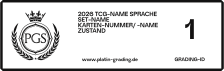
PGS Standard Label (no subgrades)

Standard Label

Below grade 7.0

Focus on the essentials: the clear overall grade without subgrades.
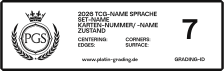
PGS Standard Label with subgrades

Standard with Subgrades

From grade 7.0

Full transparency with all subgrades: detailed individual assessments for centering, corners, edges and surface.

PGS Gold Label

Gold Label

The ultimate

Only those who achieve 4× grade 10 across all subgrades receive our golden special label – the crown of any collection.

Card requirements.

These TCGs and formats we accept.

Accepted TCGs

PokémonYu-Gi-Oh!Magic: The GatheringLorcanaOne PieceDragon Ball SuperDigimon+ all common trading cards & stickers

All cards and stickers in standard format are accepted. Cards and stickers smaller than the Japanese format fall under our Sticker Grading category.

Dimensions & Formats

Standard format (max.)63.5 × 88.9 mm
Maximum thicknessup to 150 pt (~3.8 mm)
Japanese format59 × 86 mm

Small formats & stickers: To guarantee a perfect fit and protection inside the case, we secure small formats with an additional, custom-made acrylic holder.

Ready for your assessment?

Have your cards graded by one of Germany's leading grading providers – fair, precise and transparent.